
INTRODUCTION

PART ONE
The other night, I watched a video essay about Star Trek as neo-liberal, capitalist propaganda. I don’t think it’s a stretch to point out that the United Federation of Planets is just the United States IN SPACE!!! Nor is it particularly revelatory to point out that the values which dominate most incarnations of the show are largely the values of liberal democracy, post-World War Two. Again, This is not surprising considering the original series was written and produced during the LBJ administration; this was a high point and logical conclusion of the New Deal program for the country, started thirty years earlier by FDR. The essay brought up valid points about the fundamentally hierarchical structures of Starfleet, about its characterization of the space navy as an instrument for good, civilizing the wild reaches of deep space with a healthy dose of late-60s liberalism.
One could even go back a century and connect the Star Trek mythos to the westward expansion and Manifest Destiny, with the enterprise standing in for a company of US Cavalry, but, you know, a racially diverse US Cavalry. Wouldn’t we all feel better about the genocide of the Native Americans if Mr. Spock was there to point out the ill-logic of liberating a people by murdering them? So this critique is fine so far, though to be fair to later Trek, Next Generation, and especially Deep Space Nine did look at the contradictions of the initial show, and grappled with the moral quandaries inherent to government power versus the conscience of the individual. But the critique missed a point that I think is crucial, not just to understanding the lore of the hypothetical space navy, but to understanding a fundamental tension of political economy since the dawn of agriculture. And this missed point involved the replicator.
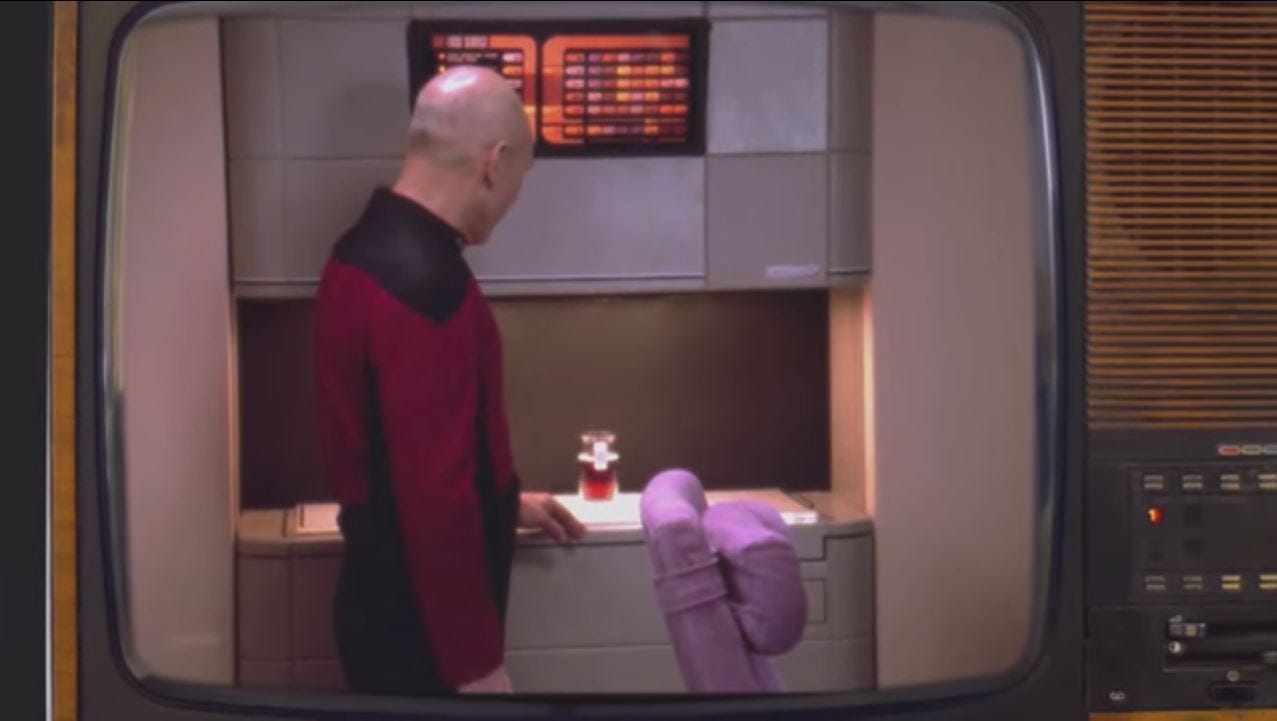
Setting aside the magical nature of bending of the laws of physics, not to mention the computing power that must be necessary to assemble random atoms into “tea, Earl Grey, hot,” technology like the replicator would represent a true watershed moment. Imagine for a moment a world where 3-D printers were ubiquitous and capable of printing almost anything. I don’t want to bend the aforementioned laws of physics too much, so let’s not assume they can print food or a new car, but they CAN produce anything close to the size of the machine itself. Even if they can’t print a new car, they could print the parts to build one…
In such a scenario, as in an essay on the economics of Star Trek, creator Feral Historian posited that replicator technology really could be BOTH an end to scarcity AND a way of moving control of the means of production into the hands of the many, rather than the few, or the one. That wasn’t a Marxist reference, either. If you didn’t get it, come back to this essay after you’ve watched Wrath of Khan.

As a quick aside, we should define ‘means of production’ versus ‘modes of production’ just so we are all on the same page. In the, typically Marxist, reading of economic history, ‘means’ of production refers to the physical things used to generate wealth by a society: machines, factories, raw materials, etc… The mode of production usually means the human systems by which a society organizes economic production: feudalism, mercantilism, capitalism, socialism, syndicalism, etc… For the purposes of the following posts, we will mostly talk about the means of production, though occasionally, the modes of production may rear their wooly heads as well.
That said, there is a Marxist-adjacent point to be made here, both about the hypothetical future, and the dreary recent past. Unfortunately, since time immemorial, or written accounts of it anyway, human economies across time and space have been a repeating cycle of a tiny in-group controlling the means of production. In ancient Sumeria, that meant control of the bronze-making process, and by extension, control of access to irrigation networks, which were crucial to survival in the Fertile Crescent in the 4th millennia BC. Control of that farmland, and the excess wealth it created, made the cities of Ur, Uruk and later, Akkad, wealthy beyond imagination. At least at the time.

Over the centuries, the modes of production change, but the cycle remains depressingly familiar. Most often this meant the means of production involved one form of coerced human labor, augmented by animal and some mechanical power. Eventually, the means of production shifted to using fossil fuels in place of human labor over the course of the 19th century. In each case, a small clique secures control of the means of production, and everyone else labors to make them fabulously wealthy. And as with each elite in-group before them, the industrialists got bored, or perhaps frustrated that their palace wasn’t as magnificent as the neighbors, so they celebrated with a cataclysmic conflict that the rest of us must suffer through. The edifice of empire collapses, the old means of production become widespread, humanity takes a step up the tech tree, millions die prematurely, and a new group seizes control of a new means of production. Rinse. Repeat. Hooray. Prograss.
But let’s bring things back to replicators and Star Trek, shall we? There’s one of those cycles of control of the means of production that bears further investigation as we progress through this, so far utterly shitty, 21st century AD. But to examine the future, we have to investigate the past. Look around the house for a serape and a pair of organic, free trade sandals, preferably hemp. Next week we will take a stroll along a mountain path!
PART TWO
As we start part two of the current series of posts, we need to take a quick jaunt to Minneasota. This is not due to current events, but to the publication of an outstanding paper from the Minneapolis Federal Reserve in 1996. There, economist Naryana Kocherlakota penned a paper titled “Money is Memory.” In it, he posits that “Memory is defined as knowledge on the part of an agent of the full histories of all agents with whom he has had direct or indirect contact in the past. Money is defined as an object that does not enter preferences or production and is available in fixed supply. The main proposition proves that any allocation that is feasible in an environment with money is also feasible in the same environment with memory. Depending on the environment, the converse may or may not be true. Hence, from a technological point of view, money is equivalent to a primitive form of memory.”
“What is the economese is this man talking about?” you may ask.
Money allows for the users to not hold a history of transactions; you do not have to remember the entire history of give and take with someone else to use money, and thus it makes exchange much easier. People viewed gold and silver as the two metals rare enough and pretty enough to serve this role for a long time, but those mediums of exchange were NOT ledgers of account the way modern fiat currencies are. Without getting distracted by the fiat vs metal debate, the modern system of money and accounting is, at least in the US, only as old as 1913, the year of the founding of the Federal Reserve system. Depending on point of view, the modern monetary system is either an extremely elaborate trust exercise, a giant collective folley, or a bit of both. Any way you slice it, this is an amazing principle of monetary economics, and a great leap forward for reducing the costs to transactions. Money, as an abstract medium of exchange, ties the past to the present and to the future in a way that is relatively new (yes, I know China printed paper money first), certainly rare in human history, and thus something of an experiment.
Speaking of the past, let’s take that trip to the mountains. The Andes Mountains specifically, around the year 1438 AD. Emperor Pachacuti’s army just defeated the invading Chanka and stood poised to expand from central Peru in all directions. And like every other great empire in history, this empire would build extensive road networks, enable trade, build temples and monuments, and integrate a wide variety of people into a single state. By the arrival of the Spanish conquistadors in 1532, the Inca Empire stretched 2,500 miles north to south, and operated the largest land empire in the Americas. And like so many other empires, it didn’t just run on a highly militarized state pushing around a bunch of peasants. The Inca (who were a ruling class, not an ethnic group or nation state) controlled access to a key resource: llamas.
Marxist scholars would classify the mode of production in the Inca Empire as a tributary mode of production; the state extracted tribute from the laboring masses in exchange for stability, appeasement of the gods, and, one assumes, not killing them. But what interests us just now is not the mode of production, but the means. And in the Andes in the 15th century, the means of production were llamas. As adorable and derpy as llamas look, in the 15th century, control of llama herds meant control of the one source of large animal labor on the continent, and in the context of the Incan Empire, private ownership of llamas was strictly forbidden. All herds belonged to the state which was run by the emperor, the Sapa Inca. And what made the llama so important, other than their muscle power, their meat, and their cute, doofy faces? Their wool.

The people of the Inca Empire spun that wool into yarn, which they turned over to imperial administrators as taxes. This yarn was then turned into any number of useful goods, but perhaps the most important was rope. It served the obvious function of securing loads of goods to llamas, but the uses don’t stop there. The Inca built bridges across the yawning chasms that separated people on one ridge of mountains from another, using little more than llama wool ropes and wooden planks. Llama wool literally held the empire together. One wonders if Dr. Seuss based the thneed on it, given its almost universal set of uses. Anyway, the Inca empire itself was a highly centralized regime. There was no private property, only state property. And the state controlled the llamas. Before you run away screaming this was some proto-communist evil empire, take a deep breath, because the parallels to the modern world are actually more disturbing.
In 15th century South America, llama yarn filled one other, crucial role. The Inca system of recording data involved complicated systems of yarn tied in knots called quipu. These knotted and dyed ropes could only be read by a tightly-controlled caste of quipu-readers.The average person couldn’t read the messages that moved goods from one part of the empire to another. They only received instructions and moved goods from one imperial warehouse to another. The emperor and his governors not only controlled the means of production, they controlled access to the information that ran the empire’s economy.

The quipu was many things. In the physical sense, it was a means of production, but was also a medium for transmitting information, as well as a medium of exchange. The quipu was a physical good, a stand-in for money, AND a wealth of information. In a very real sense, the quipu was the phenomenon Mr. Kocherlakota referred to as “money is memory.” IF you knew how to read it.
Is this starting to sound familiar?
In today’s digital world, what are the means of production? Sure, oil and rare-earth metals are crucial elements. You can’t make a microprocessor without them, but they are factors, not so much the means themselves. That would be data processing. You want something built? Designed? Delivered? There’s an app for that! And who controls the data streams? Big tech companies like Google. Amazon. Facebook. Microsoft. Palantir. NVIDIA.
The similarity between the kipu-readers of old and today’s gatekeepers of AI strikes us as startling, as AI seems poised to both wipe out many jobs and empower those who operate it wildly disproportionate economic power. And make no mistake, the billionaires who control the means and mode of production are not interested in sharing that control with anyone. To put a twist on a saying by a wise old man, it’s a small club, and you ain’t in it.
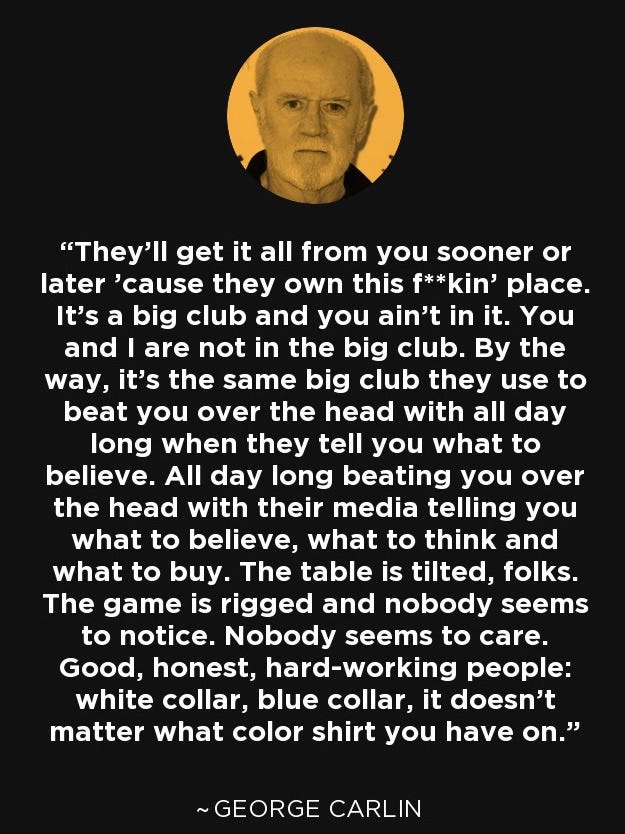
And the current efforts of that small club involve not only creating a technology that concentrates an awful lot of economic power in the hands of just a few people, but creating an economy of perpetual renters. As much as certain segments of the US electorate love to bang on about how the globalists are communists, concentrating the means and modes of production into the hands of just a few capitalists is not communism or socialism. It is the end result, one might even call it the late stage, of a capitalist system that always tends towards monopoly. But because we here at Compounding Fractures don’t like discussions of economics going in an entirely dismal direction, next week we will discuss both a technology and a technique that could help break this attempt by the Epstein Class to install themselves as the new Inca.
How do we do this? By metaphorically keeping the wool and running off with the herds. Next week, we all become llama rustlers for a day!
PART THREE
Last week we covered the concept of money-as-memory, as well as the rise of the Inca Empire. It was a busy week, to be sure, but it was ground we needed to cover to bring the discussion back to current events and the near future. Assuming we have a near future. The Epstein War is barely a business-week old and the US government is already talking about escorting oil tankers through the Strait of Hormuz and insuring those ships with US taxpayer dollars. This will become a necessity as some 20% of world oil and natural gas passes through those straits. And an industrial economy without oil and gas is like an Incan Empire without llamas. Speaking of the economy…
…by more than a few metrics, the US economy is in recession, right now. Well, except for the part of it tied to data centers and information technology. The circle of debt trades and stock valuations, combined with the building of more and more data centers, are the only section of the US economy showing any signs of growth. The Epstein class and the corporations they control hoover up every spare cent they can find to finance data centers, the modern-day quipus. But lest you think that slicing off a little sliver of that pie will keep you fed, remember, in this economy, the costs get foisted on all of us, while the gains go to the ownership class. The 0.1%. As with the Great Recession, they are privatizing the gains, while socializing the losses.
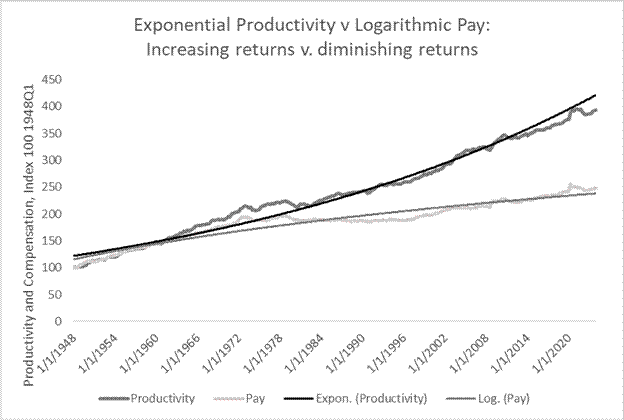
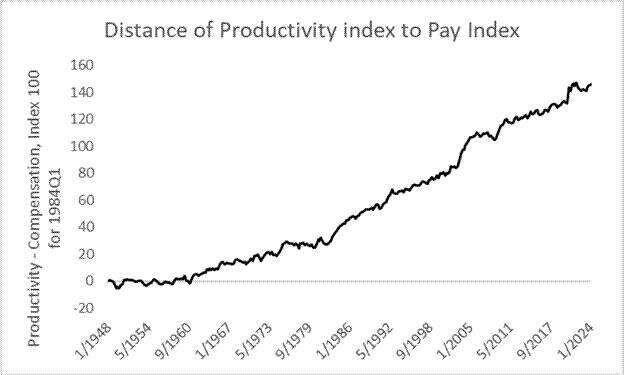
In our book, Inequality By Design, Dr Mattson and I lay out in macro terms, how the rise of computing technology failed to deliver the promised economic gains. Sure, you as a cog in the machine worked more efficiently, but you didn’t share in the profits. And if you happened to work for one of those IT firms which promised employee ownership in the 90s? If you were lucky you worked for Google. More likely, you worked for any number of the mid-sized companies that got bought out by larger firms, and you were forced to sell your stock, patted on the head, and shown the door. Once again, we can’t socialize those gains, can we?
For now, what can we do to combat the expansion of the techno-feudal state? For starters, oppose the establishment of data centers in your locality. Don’t fall for the claims about permanent job creation, or the smokestack chasing mentality which assumes that money will just go elsewhere, so it might as well come here. If economic history teaches us anything at all, it could be an axiom that the profits go up, and the costs roll downhill, leaving the population asking questions like: Is your drinking water now poisoned? Is your electric bill tripling? Where are those permanent jobs?
Once again, we see the capitalist privatizing the gains and socializing the losses. But we promised a vision of a better future, did we not? This brings up back to Star Trek and visions of sugar-plum futures dancing in our heads. In one sense at least, the Star Trek vision does indeed offer a positive vision. How liberating would it be, if everyone owned a replicator? Or, at the very least, had free access to one? What could we humans achieve, if the means of production really were in our hands, and not the hands of some elite in-group?
But such a transformation requires two things to change. One - the modes of production must shift away from capitalism, in which the entire engine of the economy is controlled and operated by private interests. One option we could shift to is syndicalism. Under this arrangement, people own and control the companies they work for, which operate in the context of a free-market economy. No central control by rapacious capital or central planners, just people working for their own profit.
If syndicalism represents a shift in the modes of production, then on paper, 3-D printing offers a technology that could wrest control of the means of production from the hands of the Epstein class. So far, it has turned out to be a fun toy with some useful applications. You can print some medical devices with one. More importantly, you can print a gun with one! This being America, if a new technology can’t find an application under the 2nd Amendment, what even is the point?
And that is a real question, isn’t it? What is the point of writing about the means of production in a post-Marxian age? As the propagandists of the Epstein class would have us believe, we aren’t in the late-stages of capitalism, rather, we are in the beginning stages of techno-feudalism. If the fascists and their financial backers get their way, the USA will become a collection of provinces run by techno-feudal lords. Each barony or dukedom run by a CEO who controls the data streams, the modern quipu.
Think you can escape, peasant?

We must resign ourselves to this new normal, right?
I doubt it. For starters, these data streams are much more complex and resource intensive than knotted strands of colorful llama wool. They rely on supply chains of a complexity that puts the late-Bronze Age trade networks to shame. As the global order cracks up, it looks increasingly likely that those computer supply chains won’t survive. The most advanced micro processing facility in the world operates out of a single factory on the island of Taiwan and relies on a supply chain involving literally thousands of companies. Our techno-feudal overlords will send underlings scurrying across the globe to create workarounds in the wake of the failure of any segment of that supply chain, Their prestige and control relies on it. But in those gaps, the rest of us could seize opportunities. Fortunately, basic 3D printers don’t require the same sophisticated microprocessors the data centers do. Not for building simple tools and parts. And as with the past, so will be the future. The new technology becomes widespread, its impacts diffuse, no longer favoring the elites.
This essay is not meant as a fluff-piece for the 3D printer industry, rather, we wish to raise the point that until we tackle the root causes of economic inequality, the control of the means of production by tiny elites rather than the people, all other attempts at reform are little more than tinkering around the edges. As ugly as things may seem now, with the rise of mass surveillance and concentration of economic power in the hands of literally a few thousand people, the future of the dark enlightenment is not inevitable.
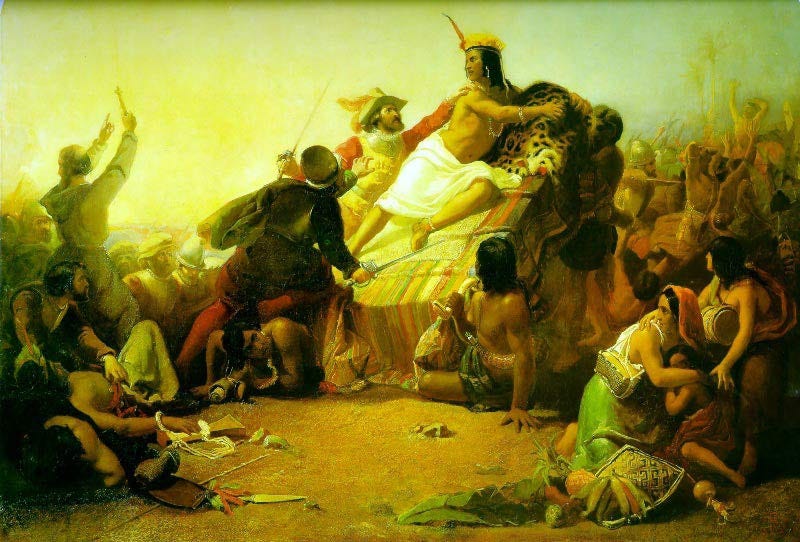
The Inca Empire collapsed largely due to outside forces: the arrival of Eurasian diseases and Spanish conquistadors, but not due to those forces alone. Atahualpa, the last Sapa-Inca, had just finished securing his power at the end of a bloody civil war, when Pizarro and his conquistadors ambushed him at Cajamarca. It has been suggested by more than one historian, that Atahualpa dismissed the threat the Spaniards posed because he was riding high, drunk on the hubris of imperial victory.
It takes no stretch of the imagination to see similar elites in the modern world acting as if their victories come with no price, with no strings attached, facing no adversaries who might dethrone them. That inattention to the world shifting beneath their feet offers us the finest of opportunities. The edifice of empire is daunting, but not indestructible, and the first step in bringing it down requires we recognize the empire for what it is: the false promise of peace and stability, but fundamentally a mode of control. So ask yourself, how can I, and my community, take the first steps in wresting the means of production from the elite? How can we become the llama-rustlers we want to see in the world?

No comments:
Post a Comment