Just put some more summer squash in between the corn mounds, as it looks like the last round failed to germinate.
Planted some oregano and basil in the bare spots of the keyhole garden to keep the spinach, kale and peas company.
Planted a row of bush beans around the inside of the keyhole garden w/ the okra. On that note, the okra does not seem to be putting up sprouts, so I will probably need to plant the Clemson Spineless that I bought a few days ago to make sure we have okra by summertime. All for now.
Thursday, March 26, 2015
Wednesday, March 25, 2015
The first greens of spring.
We are just a few days away. With that in mind, I went out weeding in three sisters garden and took some pictures of the kale, spinach and peas growing in one of the keyhole gardens.


Not much of the corn has made it about ground yet, and it went into the ground two weeks ago. None of the squash plants have emerged either, nor has the okra. I planted them early this year because we had such a mild winter. Also, Senator Inhofe brought a snowball onto the floor of the US Senate as proof that global warming isn't happening. I thought that would be a good barometer for how soon spring would arrive, and the temps and rain have not disappointed.
 | |
| Newly planted Apache and Arapaho variety blackberry bushes to replace the bush the dogs chewed to the ground. |
 |
| First corn sprouts of spring. |
 |
| Spinach on the inside of the arc, pea plants in the middle and kale on the outside. |
 |
| View of the whole garden. |
Monday, March 9, 2015
Springtime Begins the Planting Season.
Spring planting begins!
I have not posted in a while. Any gardener knows the winter upkeep is less than flashy. Turn compost here, keep strawberries covered there, and so on. But now that temps are above freezing in Oklahoma, the time to plant begins.
I have not posted in a while. Any gardener knows the winter upkeep is less than flashy. Turn compost here, keep strawberries covered there, and so on. But now that temps are above freezing in Oklahoma, the time to plant begins.
 | |
| Important ingredient: cow poo. Not dog poo. |
 | |
| Two rows about 15 feet in length. Future site of corn, beans and squash. |
 |
| Keyhole garden w/ spinach, kale and snap peas. |
 | |
| Keyhole garden #2, planted okra in it today. |
 | |
| Complete corn mound. |
 |
| Another completed corn mound. |
 |
| Hello garlic! (planted in November.) |
Friday, September 12, 2014
September Update
 As I mentioned in a previous post, one side of the raised bed seemed to be doing better than the other. At the time, I concluded that it might be because the south west side of the raised bed was not getting enough water, or maybe too much sunlight, or that the cardboard under the soil and much didn't have big enough holes in it to allow the plants to sink roots. At one point, I even blamed the underlying soil. As the summer wore on, I concluded that, of course, the problem stemmed from a lack of water. This being Oklahoma in July and August, the lack-of-water explanation seemed to jive with the wilting. Then, everything but the okra dried up and died in about a week.
Around this time, I discussed the problem with a friend of mine, and he suggested that the problem may be that the chipped straw product had been mixed with with salt-treated sawdust to extend shelf life. I had not thought of this, and it certainly would explain the fact that everything shriveled up and died pretty much at once. So, in the spirit of experimentation, and the fact that i didn't this stuff contaminating potentially productive soil, I dug up the raised bed (below) made with the straw chip product. I tossed it on the weeds growing along the fence. The dig-up ended last week. You can see the early results


 |
| Coming soon: a pumpkin patch! |

I planted one set directly into unamended soil, and the other set went into a 1:1:1 mix of black gold gardening soil, peat, and local soil. I built up this combo of soil into a makeshift raised bed. Both areas receive roughly the same amount of sun, and bout will receive the same regular watering regimen.
I planted each set (looking at the pictures) at deep-to-shallow. On the right end of each strawberry mini-field, I planted at a depth of 2 inches, 1 inch in the middle, and barely a half inch on the left end. We will see what the results yield.
Yay science.


 |
| The rescued slippery maple seems to be doing fine. The compost is cooking down nicely. The chicken coop is still empty. |
Tuesday, July 1, 2014
North versus south
 |
| The north side of the first raised bed seems to be doing well. |
 |
| For some reason, the south side of the raised bed has done rather poorly, except for the squash in the NE corner (top of picture). The SE corner seems exceptionally bad. I've lost an okra plant and it looks like I'm about to lose a squash plant. |
 |
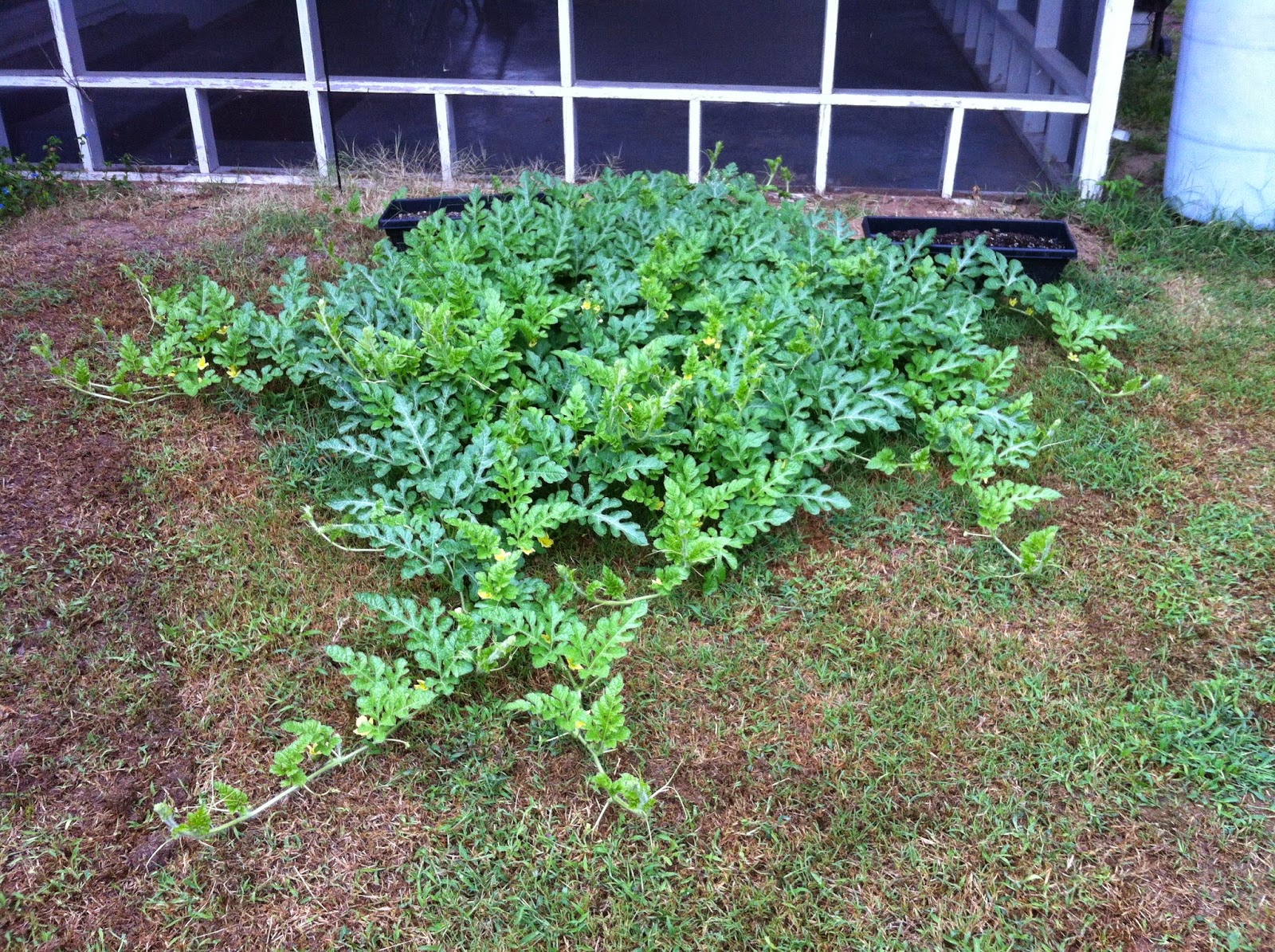
| You can see the squash sprout that hasn't done mush growing at all. I dug down to the soil which the straw slowly covered up and planted watermelon seeds. Hopefully they take. |
 |
| The blackberry bush may have finally hit its stride. |
For some reason, the plants in the northern half of the raised bed have taken off. The corn stalks are sending up green leaves from the tops of their stems. The runner beans put out big green leaves and should be putting out their runners soon. The squash seems to be doing the best. most of the plants have big green leaves, and I'm hoping I've started them late enough to avoid squash borer attacks.
I was talking to one of the men who operate the community garden around the corner about their efforts to grow squash. He said the only organic way to combat them involves planting squash later in the growing season to disrupt their life cycle. According to Joe, the squash borer is actually a wasp that lays its larvae in squash blossoms. The larvae then eat the blossom from the inside out and fly off. Nature can be gruesome. After the squash borer has done its damage, the gardener is left with a superficially healthy plant that never produces a gourd.
Back at the raised bed, I've found that all the plants on the south side of the raised bed seem to be, at best, sickly looking, and at worst, dying. I'm perplexed because I didn't vary anything about the planting between different parts of the raised bed.
Tuesday, June 24, 2014
Three Week Update
 |
| Raised bed: In the foreground, you can see the squash and beans taking well. The transplanted corn still looks yellow after three weeks in the ground. It appears all the stalks are experiencing some serious root shock from the move. |
 |
| Raised bed: I planted basil, cilantro, fennel and a new okra plant just beyond the edge of the raised bed. On the right the transplanted okra seems to be getting on just fine. Contrast that with the corn directly behind it. |
 |
| The blackberry bush needed some serious grooming. Quite a few of the leaves on it's lower branches dried out and died. The tips of the branches put out new growth since the planting (June 7th), so I think the bush is starting to hit it's stride. |
 |
| After some renovations to the gutter system, the rain barrel is now functional. The rain yesterday (June 23rd) was enough to take the water level from just above the spigot to where you see it now, just under the 50 gallon line! |
Saturday, June 7, 2014
Sometimes you have to do some digging to make a raised bed...
Put in the first raised bed and a Ouachita Blackberry bush. Trying three sisters in a raised bed, which I have not done before. Put in fourteen corn stalks, with two runner bean seeds planted next to each stalk. Planted acorn squash in between the corn and beans. Also planted five okra.

 Food scraps and some brown paper bags make up the green manure.
 A layer of cardboard over the scraps, on top of which I spread chopped hay. I punched holes in the cardboard in the openings where the plants ended up.

 Three sisters plus okra in the ground. They are planted in a mix of potting, garden and raised bed soil.

 Ouachita Blackberry bush, planted in hill country soil.
Subscribe to:
Posts (Atom)