Showing posts with label history. Show all posts

Tuesday, March 17, 2026

This Is What Accountability Looks Like

Here at Compounding Fractures, we consider ourselves fans of accountability. Dr. Mattson and I discussed, in the wake of the 2008 Great Financial Crisis, the moral hazard of, for instance, letting bankers get away with blatant fraud. This principle extends not just to prosecution, but also to people taking responsibility for their actions in a public manner. For instance, when it becomes obvious that tax cuts for the rich don’t grow the economy, and just drive up government debts and deficits, it would be nice to see those pushing the idea resign from whatever position of public responsibility they hold, walk into the sunset, and never be heard from again. So in the spirit of accountability, I thought it might be worth examining the projections made in last year's post about positive reconstruction.


As I noted in the original post kicking off the series, I did not think the exact scenario would come to pass. The Positive Reconstruction Scenario outlined trends to keep an eye on, trends which might indicate whether we are even on the path towards positive reconstruction as all of this *gestures broadly* falls apart. And make no mistake, *this* is most certainly falling apart. One way or another, we here in the US, and likely a number of other countries around the world, are most certainly in for a reconstruction of the political economic order. All the remans to be seen at this point is whether that reconstruction will be largely positive, or negative. But more on that later. For now, let’s examine the trends.


In the opening post, I suggested the bad economic policies of the current regime would push unemployment to 5% by the end of 2025. Officially, unemployment sat at 4.4% at the end of the year. Setting aside the problem with the short term unemployment rate vs labor force participation and long-term unemployment numbers, our prediction was too high. That said, the last twelve months of BLS jobs numbers appear to be, shall we say, methodically wrong. Each jobs report number has been revised down, with a number of months yielding negative jobs numbers when they’d previously been reported as positive. In other words, who knows? Maybe we are actually at a 5% unemployment rate? Taking a metaphor from baseball, the umpire called a third strike after changing the size of the strike zone. This makes it difficult to know when to swing the bat and when to leave it on your shoulder, because the strike zone becomes whatever the umpire’s boss decides it is.


Okay, the regime can cook our books internally, but not so with exchange rates, right? I speculated that the dollar would drop a full 15% in value against the standard basket of currencies. While the dollar certainly did drop by more than that against currencies like the Euro, Peso, Krona and Real, to name a few, it didn’t drop nearly as much against other major currencies like the Yen and Canadian dollar. Against the full basket, the dollar index dropped from 108 in January 2025 to 98 by December, a drop of roughly 11% overall. I’ll grant that isn’t the full 15%, but it stands in stark contrast to the administration's claims the dollar would be stronger as a result of tariffs and trade wars. This one is a bit of a foul ball. We made contact with the ball, but it didn’t end up where it should; the dollar didn’t fall as far as expected.


Another specific claim that proved, thankfully, inaccurate, was the suggestion that a certain major US city would see its immigrant mayor deported and the city erupt with anti-ICE violence as a result..I’ll be glad to hold that L for now, though this administration hasn’t been above threatening political opponents with denaturalization and deportation, so I wouldn't trust them NOT to deport a legitimately elected mayor. After all, they’ve arrested sitting members of Congress and virtually declared war on a decent sized American city in December of 2025. On second thought, maybe my guess on intent, as opposed to the specific facts, wasn’t exactly wrong. In the post about 2025, I did say I expected to see a large-scale assault on an American city by ICE in late 2025, which did happen. It just didn’t happen to NYC, but Minneapolis instead.. To continue the baseball metaphor, this prediction would be a hit that didn’t go how you expected, like hitting for an infield sacrifice fly, but ending up safe on first after all. 


To sum up, the 2025 predictions were a mixed bag. At this point, we have a questionable strike zone, a foul ball, and a runner on base. Nothing hit out of the park, but as of my first draft of this post, indicators appeared largely moving along the lines of a positive scenario. But I wrote the first draft three weeks ago. Which leads us to today. Nowhere in the positive reconstruction scenario did I think or even suggest the current administration would be stupid enough to start a war which threatens to send oil over $150 a barrel and cause a global depression. I genuinely expected the administration to focus on clamping down on internal dissent and thoroughly cooking the books before turning their aggression outward. This drastic escalation does not bode well for a positive reconstruction of America’s political economy. Indeed, the game has been delayed due to a thunderstorm, which will make a complete mess of the field.


If the Epstein War lasts longer than a month (and we are already two weeks in), we will likely see oil pass $200 per barrel and, more ominously, supply shocks to the global system for producing fertilizer. As of now, there’s still time for oil markets to recover. Yes, we’ve lost about 15 million barrels per day of exports from the Persian Gulf, but those tankers take weeks to get to port and unload, so we could avoid real supply shocks if exports resume tomorrow. However, that may not happen for a variety of reasons, not the least of which is that Iran has a say in how all this plays out. Right now, credible reports indicate Iran is placing mines in the Strait of Hormuz. Iranian officials have stated they might even push the conflict through the US midterm elections to make sure the regime pays a political price for their attack. So far, Iran carried out attacks on at least 11 ships attempting to run their blockade. Those don’t appear to be the actions of a power interested in de-escalating the conflict, does it?


At this point I should note that Iran IS allowing exports of their oil. This mostly means to China, but I’m sure Iran will sell to anyone with hard cash. They aren’t allowing their Gulf rivals to export their oil and gas. One wonders how long the US Navy will allow that state of affairs to continue. Over the medium term, Saudi Arabia might be able to move about 2 million barrels of oil by pipeline to the Red Sea, but that will take months, if not years to achieve, and does nothing for Iraq, Bahrain, Kuwait. So the supply shock to the global economy WILL happen sooner or later if this conflict goes on for four to six weeks. And what happens then?


Well, in 2008, oil hit $150 per barrel and played a large role in causing the 2008-09 recession, which made the unfolding Global Financial Crisis even worse than it already was. Then the oil price crashed back down to about $30 per barrel. Which sounds great, but at that point, millions of people had lost their jobs or income, so they couldn’t afford to buy oil anyway. The root of the problem is that oil and gas goes into just about every good or service produced in the industrial world. Even if petroleum products don’t literally go into a product, they contribute in some way to the creation of every good or service. 


The effect will be to drive up prices for everthing, everywhere, all at once. If you think the COVID supply shocks and inflation were bad, let’s see what a six week disruption does. In fact, $200 per barrel is not unrealistic, as consumption is higher in terms of total volume than it was in 2008. And crashing the global economy may be just what Iran has in mind, considering the US sits at the center of the global economy and disproportionately benefits from it. Which also means it is disproportionately exposed to shocks to the global economy. And before you point out that the US currently imports less oil than ever these days, keep in mind that oil is a global commodity. If the price goes up outside the US, it will drive up the price domestically too, because if that price goes high enough, US oil companies WILL start exporting to the highest bidder. And even if controls on exports get slapped on exports, the US still imports about 30% of the oil we use daily. So we will have to deal with a supply shortfall or we will still have to pay more for those imports. 


And what would that imply for the positive reconstruction scenario? I expect the effects to be similar to the negative reconstruction scenario, though not the dystopian one, in one key way; the economic depression which the Epstein War will probably cause, will destroy whatever credibility the US ruling class could claim. And while one might say the ruling class lost credibility some time ago, that reality hits differently when the unemployment rate tops 10% AND inflation is out of control. It's one thing to tolerate the antics of an out-of-control elite when you can still buy bread. It’s quite another to put up with the clown show when even those with jobs can’t make that last dollar stretch. While it isn’t particularly germane to today's problems, I think the lack of inflation in the wake of the GFC was one, if not THE factor, that saved the elites from pitchforks and torches at the time. Now, they do not have that security blanket. 


So again, what does this imply going forward? For one, it means we can likely scrap the dystopian scenario I laid out early last year. It appears the foolishness of the ruling class is now so clearly beyond redeeming, a collective reckoning is all but unavoidable. At this point, the only question is will that reckoning play out in a positive manner or not. Will political control and economic prosperity devolve back to the huddled masses through largely peaceful means, or will that devolution happen because revolutionary violence wrenches control of the political economy of the United States away from distant elites in Washington and New York? For a guide of what that might look like, next time, we will visit the Soviet Union in the year of my birth, 1982.

Friday, October 24, 2025

Positive Reconstruction in 2029

I'd gotten away from posting to this blog, as I've mostly moved the posts from the Positive Reconstruction series to Substack. Ryan and I are still posting regularly to Substack under the title Compounding Fractures, to both promote Inequality by Design, as well as speak on current issues. We have series on Universal Basic Income, State Capitalism, and of course, this fictional series about the future direction of the United States. If any of that interests you, please head over there, peruse what we've written, and subscribe if you like what you read. 

Without further ado, here's the next post in the Positive Reconstruction series: 

2029 - The Eye of the Hurricane

By January 2nd, half a million citizens surround Washington. They carpool, take buses and trains, they sit in cars, crash on friend’s couches, they rent rooms, and some even camp out at parks a day’s walk from the borders of the district. The people bring signs, they bring food, they buy bottles of water for fellow travelers. Some bring hopes and dreams. Some bring cynicism or opportunism. And yes, a great many of them bring guns. The Congressional session for 2029 is scheduled to start January 3rd.

Happy Winter Solstice! A wintry sunrise in Dorchester County, Maryland.  Cheers to the light in our lives, whether literal or figurative!
I know, this is from Maryland's Eastern Shore, but a picture of the sunrise on the Winter Solstice is too poetic to pass up.

In the last days of 2024, military bases around the district cancel leave and stock up on MREs. Junior officers and NCOs scour strip clubs and flophouses for the enlisted men and women missing from morning muster. In some units, desertion rates reach 40%. For those still on base, many report to the infirmary. Accident rates spike on bases as troops become desperate to avoid the orders they know will come down. On January 1st, several combat regiments are mobilized and deployed to interchanges along I-495 in Maryland and Virginia, just outside DC. The governors of both states ask the federal government to remove the troops, and get no reply.


Early on the morning of January 3rd, half a million Americans wake up, partake in the early morning rituals of eating breakfast, cleaning up, and start towards the nation’s capital, unsure if they will live to see the sunset. It may seem cliché in an age of global supply chains, information superhighways and trans-national corporations with budgets larger than the GDP of entire countries, but control of the levers of government still matters. America rolled the dice in 2024 and wound up in an era of lawlessness and rampant corruption, both monetary and moral. These things happen fairly regularly to peoples all around the world and throughout time. So on a not-so-chilly January morning, the country rolls the dice one more time.


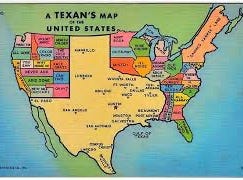
The notion of who sits in the halls of Congress by the end of the day isn’t just an issue about changing the window dressing at the Capitol. In November, 16 states put secession on the ballot. The language varied a bit from state to state, but most followed the line “if the federal government refuses to seat the lawfully elected senators and congresspeople of this state, will the state consider itself sovereign and independent of federal law?” Yes or No? Of the 16 secession referendums, only one failed. And that one failed because the state, Texas, voted it down in favor of another referendum to break the state into 5 separate states and form the Lone Star Confederation. If everything is bigger in Texas, and secession is a ‘go big or go home’ proposition, Texas voters chose to go that extra mile.

How Big is Texas? You Won't Believe How ...
I swear, this is how people south of the Red River see the world.

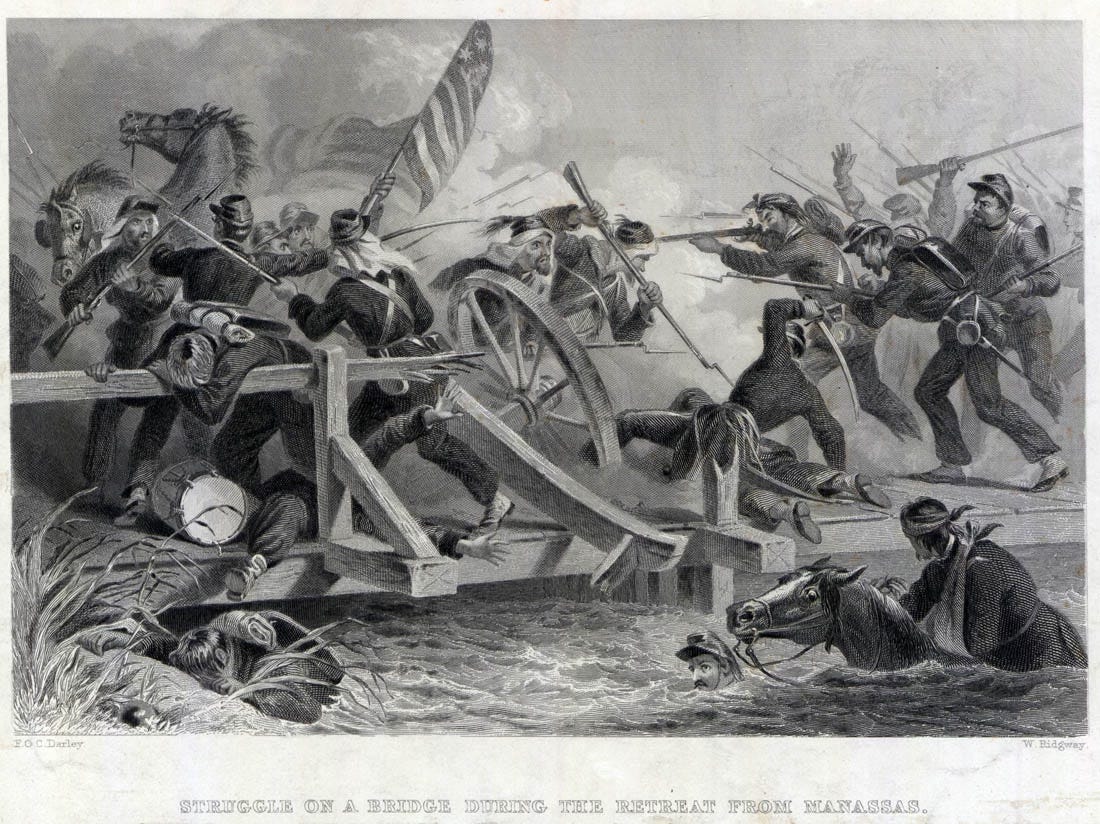
While the Solidarity Movement is largely decentralized, the President-elect and Congress-elect do agree they shouldn’t approach DC in one group, as every one of them knows how drones work. So the President-elect approaches, along with some 50,000 supporters and much of the congressional delegations from the Northeast Corridor, from Baltimore. The VP-elect and much of the Southern delegation gather and march from Manassas Junction. Other delegations and their supporters depart Bethesda via I-70 for the district.


Yes, the southern delegation met up at THAT Manassas before heading to DC.

In a moment made for history books, a half-strength platoon of nervous Air Force MPs halt the President-elect and their supporters at the I-495 overpass over Good Luck Road near Carrollton, MD. 


Good Luck Road at the I-495 overpass. History sometimes happens in the most unassuming places.

The MP’s commanding officer tells them to turn back, that they constitute an unlawful assembly. Ominously, drones approach, hovering over the people massed on the two lane road. The President-elect asks if the CO intends to betray his oath to the Constitution and receives the retort that his orders are lawful. A tense standoff ensues until word runs through the crowd that the Solidarity delegations from California, Nevada and Utah have been waved through the blockade at Friendship Heights and have made it as far as the Washington National Cathedral. A woman in the crowd shouts at the MPs that the blockade is over and if they fire on the crowd they’ll just be murderers. The CO orders his men to do just that.


The MPs refuse. Their NCO and junior CO arrest the senior CO and let the Solidarity people stream past. 


Later, people on both sides of this confrontation find out these reports weren’t entirely accurate. The blockade was still intact at the DC-MD line in the area of Friendship Heights, but when asked, the Army CO told the delegates the Metro system was still running. With a less-than-subtle wink, the CO stated that his orders only covered the surface roads. The delegates and their supporters made history by getting on the subway and simply riding it to the Capitol building.


Similar events play out repeatedly around the area. By lunchtime, two hundred thousand people are milling around on the National Mall, and supermajorities of the new Congress are ready to take their seats. In a scene we’ve seen before in this series, both DC and Capitol police refuse to block entrance to the Capitol Building, and in the case of the Capitol Police, actually arrest ICE and DHS agents that try. While the Solidarity-dominated Congress sits at the Capitol, the remainder of the regime barricades themselves in the White House.


Congress swears in the President and VP-elect, an event which is broadcast and live-streamed to the whole country. The President calls on all 50 states to recognize the new Federal government, and in what will go down as an act of borderline-megalomania, orders the military into the city to force the surrender of the criminals hunkered down in the White House. Fortunately for both Solidarity and the nation, the generals and admirals not holed up with the regime announce they will defer to the duly elected government.


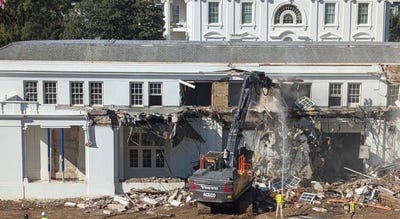
White House East Wing demolition begins as Donald Trump builds first ever presidential ballroom
The regime has a history of stiffing contractors. I wouldn’t finish the plumbing work either, if I were them.

By the time the sun sets, the Washington National Guard, the DC police, and 10,000 armed Solidarity supporters have the White House surrounded and the utilities cut off. Construction of the new bunker under the old East Wing included many redundancies for fresh water, gas and electricity.The regime declares they will wait out the besiegers until the military clears the streets. But at some point in the design process, unpaid construction workers ‘forgot’ to install redundancies for the sewer lines out of the building. The current regime emerges surrenders after three days of having to smell their own shit. On January 7th, the Solidarity President declares to the cheering crowds on the National Mall, the renaissance of the United States. Next week, we check in with the kids of the three protagonist from Inequality by Design. The week after, we will find out if Solidarity can make it stick.

Friday, October 25, 2024

The View From the Golden Mesa

    Humanity stands on a high vantage point, looking back over the past, at empires that rose and fell. We tell ourselves that the industrial world is unique, untethered from the constrains of the past. But if we turn and look to the future, we see cloud and shadow. We step forward and the ground beneath our feet undulates. The gold dust that spreads out around us bounces into the air with each step forward. Then the realization hits; what we mistook for solid ground is just a thick, black goo. The endless expanse of oil-fueled wealth does, in fact, have an edge. We stand atop a golden mesa, and beyond the edge lies a steep cliff.


Imagine the pitch meeting, "Yeah, it's gonna smell 
awful, and you won't want to go to the beach,
but it's gonna make you rich, fellas! Well,
it will make the local nobility rich..."

    While humans have know about and used petroleum oils for thousands of years, Russian engineer Vasily Semyonov drilled the first modern well near Baku, in 1846. In North America, the first commercial wells went into operation in Canada and the US in 1858 and 1859 respectively. It took a bit more than a century for oil to become the largest source of energy, in the USA by 1950, and globally in 1964. Since then, it has only grown in importance as a natural resource. Some 95% of all transport fuels are oil based: gasoline, diesel, marine fuels, and aviation fuel. Oil makes up 33% of global primary energy supplies. Add on to that the dizzying array of plastic products made from oil, and it seems reasonable tot say that no other single resource contributes more to the continued viability of the industrial age. And this primacy of oil as an industrial resource, makes the question of how much longer it will remain available for human use, important to the future trajectory of North America as an industrial economy. 

    Before continuing, I do want to address two issue: one semantic, and the other farcical. Liquid petroleum is a nonrenewable resource. This simply means it is a resource used by human beings that does not naturally replenish itself on a timeline meaningful to human beings. In the broad sense in terms of geologic time, yes, fossil fuel will probably replenish themselves via Earth’s carbon cycle. Eventually, today’s plant life and animal life will die and return to the Earth. Some small fraction of it will be trapped, compressed and heated over time into fossil fuels. How long will that take, you may ask. Well, consider that the Permian basic in West Texas, one of the most productive layers of petroleum-bearing rock in North America, formed between 485-320 years ago. The oil-bearing rock of the the relatively young field of Gehwar in Saudi Arabia, is about 160 million years old. 

Abiotic Oil Theory: wish fulfillment for people
 who's mother didn't tell them 'no' as kids.. 

    Semantics aside, I suppose this is the point where I need to address the abiotic oil theory. This theory as been around for decades, and holds that somewhere deep within the mantle, kindly Mother Earth produces new petroleum from mysterious processes. Processes which stand completely at odds with our understanding of the chemistry of hydrocarbons. Because of the tremendous pressures within the mantle and under the Earth’s crust, this a-biotic oil then seeps up to the surface to pool conveniently in cap rocks, where it waits patiently for us to use. This theory has been debunked over and over and over again, by people for understand the geology and chemistry better than I do. Even if this theory were true, which, again, it isn’t, it doesn't really matter because the rate of depletion of mature fields suggests that the Earth doesn’t replenish the abiotic oil supply at a rate sufficient to match human consumption.


    Now that we’ve gotten the minor quibbles out of the way, we should get to the core of the issue; what will the future hold for world oil production, and what does that imply for the future of North America? To assess the situation, I will focus on United States oil production, as it is three times higher than Canada, and Mexico's production has been in decline for almost a decade. With the US data, I'd like to direct your attention to the details, rather than the big, top-line numbers. And as we all know, the devil is always in the details. Much like Mephistopheles, this devil offers us a few more decades of oil, but at a very real, economic cost. And like the two horned Prince of Darkness, this devil has two horns, rate of depletion and energy returns. So let us get acquainted with the fracking devil, shall we?


    Setting aside local environmental impacts and the longer-term impacts of more CO2 in the atmosphere, both the US and Canada increased petroleum production from sources that historically have been considered unconventional. While the technology underlying both ‘tight’ oil production and oil sands processing goes back decades, until the 2000s, both sources weren’t economically viable. Until roughly 2005, the low cost of production of conventional crude oil kept global prices below $30 per barrel. But starting in 2005, global crude oil production stalled, and prices tarted to rise. Anyone reading this who bought gas in around 2008 surely remembers the high prices at the pump. Global price peaked that year at $147 per barrel. What most may not remember is that in the wake of the 2008-09 recession, global prices crashed, then rose again. By 2011, global crude prices were back around $100 per barrel. These higher prices made fracking for tight oil and digging up and processing oil sands economically viable.

Welcome to Mordor. No, wait, that's Alberta!

    Currently, a fracking  well costs between $46 and $58 per barrel, though can cost upwards of $90 per barrel, just to drill and pump out of the ground. And that price doesn’t include the cost of shipping and refining these barrels of tight oil. Tar sands run a broader range of costs, but mostly vary between $48 and $84 per barrel. Over 2023, the West Texas Intermediate price, which is the benchmark in the North American market, averaged $77 for a barrel of oil, compared with the Brent crude price of $83 per barrel.


    These trends imply two things: one - that higher prices are the new normal, to support North American oil production from unconventional sources, and that the lower priced conventional crude oil production cannot keep prices down through more drilling. 


        And who is that? Well, buried in the US Energy Information Agency projections which assume growing oil production over the next 20 years is a bit of an admission; conventional production has remained roughly flat from 5 million barrels per day in 2008 to 4.6 million barrels per day in  2023, so in a certain sense, we’ve already seen the future. This last point cannot be overstated, as it cast a whole lot of lamplight over the dim outlines of the future. North American oil production will, more and more, come from more expensive, dirtier sources of petroleum. The EIA estimates that fracked tight oil and shale gas, accounts for 64% and 70% of US production respectively.


Ignore the colorful bits and take a second look at the gray area.

    One might argue that the higher costs, both economic and environmental, are worth is to keep the petroleum party going. But before you consider fracking a solution to North America’s oil production problem, it’s worth considering that fracked wells experience much steeper rates of decline after the first few years of production. So where conventional wells can remain productive, albeit at very low levels, for decades, fracked wells typically experience decline rates of 50-75% over their first year in production, leaving them with negligible rates of production within a 60 months. While it wouldn’t be technically true to say these wells run dry within a decade, the typically have to be shut down or re-fracked, just to maintain production. This means that drillers must work fast and faster to maintain the same rates of production from any given field. In other words, fracked wells producing tight oil, won’t put an end to long term production decline. The tar sands face a similar problem, one a slightly longer timeline. Here's a good examination of that issue.


    But wait, there’s more! The problem isn’t just about the economics of tight oil and the swiftly approaching decline of oil production. Another, sneakier problem lurks in the background of all this: net energy. The light sweet crude that used to build industrial civilization and support the 8 billion or so people that live in it, was incredibly easy to get out of the ground. In most cases in the late 19th century all it took to dig in oil well was a team of mules a whole lot of iron piping and a drill bit. In most cases you didn't have to dig too deep and once you got there, the oil came to you. That first well drilled by Semyonov outside Baku, was a whopping 21 meters deep. In fact even as late as the 1920s, a lot of the oil that came out of the ground was so light and so sweet that you could literally scoop it with a bucket pour it directly into a car's gas tank and drive off. Nowadays I'm pretty sure that you couldn't perform that feat using the oil from any well in the world, even Saudi Arabia and Russia. 


Mules - keeping costs down for thousands of years.

    But the problem isn't just with refining. The energy return on energy invested in the 19th century was possibly as high as 300 to 1. Even as late as the 1920s, the energy return on energy invested was still a phenomenally good 100 to 1. By the 1950s, that ratio dropped to 75 to 1. I've read that by 1970 the ratio was down to about 50 to one which is still a really good investment but it's nowhere near what it started out at. The problem is that as improved techniques made technically difficult wells viable, more and more specialized equipment and more and more specialized people had to be brought in to produce the same amount of oil. Today, the EROEI ratio globally hovers somewhere between 20 to 1 and 4 to 1. This is of course a difficult number to qualify, especially because you're talking about investments that compound over time, but the trend is clear and the trend is down. Why does this matter going forward? 


Windmills, like mules, have a 
place in the future...

    Eventually we will reach a point where the energy invested in extraction of the resource is equal to the energy pulled from that resource. But before we get to a 1 to 1 breakeven point, we will probably pass a point where, even when the energy return is still positive, the energy return won't be enough to maintain everything else in the industrial economy which depends of fossil fuels. That's probably when the oil age will end. 


    And one might cheer the end of the oil age, until one recalls that roughly 31% of all energy used by human beings in the world today comes from liquid petroleum. 24% comes from natural gas in another 27% comes from coal. Those keeping track at home that means roughly 82% of the world’s energy production and consumption, comes from fossil fuels. The remainder is split between hydroelectric dams (7%), nuclear power plants (4.3%) and a tiny fraction, about 5.7% comes, from other renewables. Even the ‘renewable’ sources of electricity generation, wind, solar, hydroelectric and geothermal, are also produced using fossil fuels. To my knowledge, nowhere in the world uses a wind turbine or photovoltaic cells solar to produce more solar panels or wind turbines. Compounding this is the problem that industrial civilization built an entire economic model around perpetual growth. What happens when economic growth no longer materializes, because fossil fuel production is in decline, and renewable can't fill the gap?


    But again, the decline is not instantaneous, or even necessarily steep. The oil age began 180 years ago, so the implication for the future is that if we are at the end of the plateau and oil production is about to go into decline, we may have 150 to 180 years of oil “left.” The difference is this time, the about of oil produced for human use will go down, not up. And since oil is the basis of industrial economies, this implies both extended economic contraction, and eventually, contraction of the human population. 


    What will this contraction look like, and where will it end up? The global human population in 1846 was somewhere around one billion people. Industrial production was largely limited to the northwest Europe and the east coast of the United States. The population of the United States in according to the 1850 census US population was 23.1 million people. The vast majority, somewhere around 90%, lived outside of urban areas and overwhelmingly engaged in agriculture or some trade that directly supported agriculture. The estimated annual energy used per person in was 1/10 of what it is today.

... but they probably won't look like these.

    Two things: first, that the bedrock resource of industrial civilization will be more expensive going forward, and second, the fundamental, underlying problem hasn’t gone away: oil is a non-renewable resource that will not be with us forever. It's also worth remembering that when someone that tells you that we can have a future full of battery powered vehicles, lithium is not a renewable resource, or even particularly plentiful. Just like oil, coal and natural gas, it will also hit hit a peak of production and go into decline.


    But do you know what isn’t in decline? The amount of carbon dioxide in the atmosphere. Next week we will take an overview of the flip side of burning all these fossil fuels - the man-made destabilization of the climate. That's right, we're going to go where Al Gore has gone before, and talk about anthropogenic climate change!