Showing posts with label organic gardening. Show all posts

Tuesday, July 18, 2023

 The hot season arrives for real today. Over the past few weeks, July weather has been fairly subdued. No more. The highs will top 100 today and tomorrow, and look to do so again next week. Thankfully, whoever controls the weather will slide the heat dome back over to Arizona over the weekend. 

So I went out to the garden this morning to make sure my photosynthesizing friends are staying hydrated. As is typical with gardening, while out there, I noticed a number of minor tasks that needed doing. I weeded the asparagus bed, made sure the strawberries had mulch over their roots, and dug two more potato plants.

.
All the asparagus, except one, a first year plantings. Keeping grasses from overgrowing young plants in their first year, and lots of water, ensures they'll survive, and make it to year two. In year two, you can start harvesting until the first of June, then you should let them grow until the first hard freeze kills the above-ground portion of the plant. After year three, one can harvest as much as one likes. Once established, the plants will give you 15-20 years of funny smelling pee. 

Great success!


As for the strawberries, last summer was a disaster. I mulched them way too late, and the two months of 100 plus weather and practically no rain fried their roots. There were not survivors. But like the Spartans at Thermopylae, they did not die in vain!

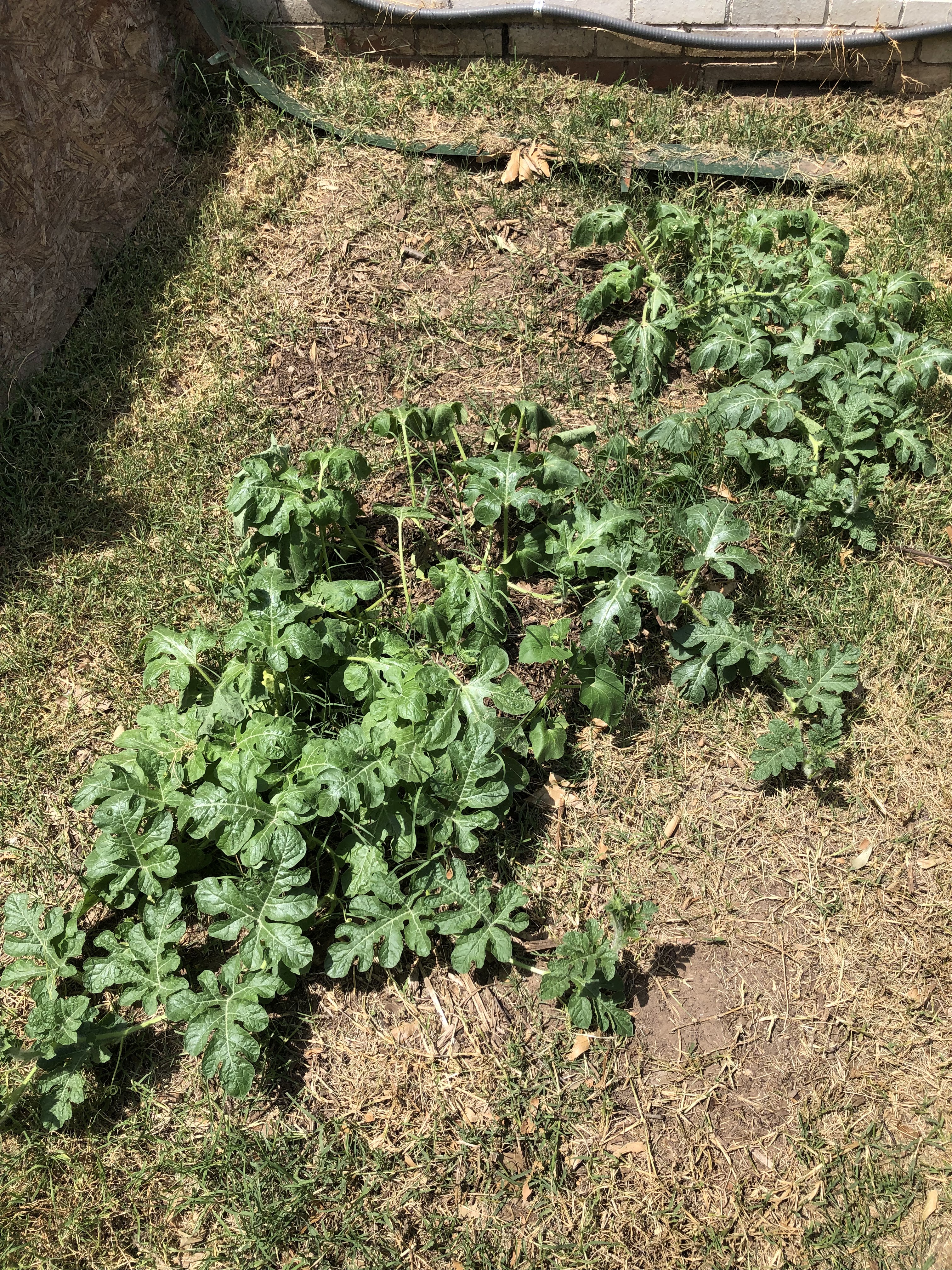
To tackle the hot summer weather this year, I've made sure to provide them with a thick layer of grass clippings atop their root beds. The downside of using grass clippings as mulch is twofold: if you mulch too deeply, the water will bind the grass clippings together and form a solid mat that can smother plants. But if you don't mulch deep enough, the heat can still reach the soil and roots. So, I companion planted runner beans above the strawberries, and heat loving watermelons as ground cover. 

This is a little bit of an experiment. I don't think they will completely shade out the strawberries, and I do think they will provide a much-needed buffer against the hot sun of late July and August. If the strawberries were still putting on fruit, I'd be more reluctant to shade them, as it would cut down on sugar formation, but at this point they haven't flowered in weeks. Once cool mornings return in October, I might cut back the shade plants and try to get a fall harvest out of them before covering them up for winter.


This fall's seed taters up top,
eatin' taters down below.

Digging the potatoes didn't yield quite what I'd hoped. The one in the planter didn't yield much, and neither the in ground one planted over by the asparagus. Companion planting potatoes with asparagus is a bit of a no-no, as their root systems can get tangled, and digging the potatoes can harm the asparagus, but I already dug the trench and didn't have enough crowns, so in went the seed potato. It was fine for everyone involved. 


Anyway, that's all for now. Off to write more fiction. Take care!

Thursday, June 29, 2023

    Last week was the Summer Solstice. I'd like to say I observed the holiday with some Celtic incantations and a hefty does of sun-worship. Alas, that was not the case. For those reading who don't keep up on Oklahoma-based meteorological events, an extremely powerful line of thunderstorms hit the Tulsa area early Father's Day morning. These storms cooked 100 mph straight-line winds, along with all the lighting and heavy rain one could ask for. The city even activated the tornado sirens for it. In tire Okie fashion, I stepped out onto the front porch to assess the storms myself  I was skeptical, until I wasn't. I watched power flashes across the Arkansas River from my home, the got hit in the face with a lashing rain that reminded me of Superstorm Sandy. By the time the power went out, I changed my mind about how 'legit' this line of storms were. 

All that is a round-about way of saying I didn't celebrate the solstice much this year as the power was out, and I had to spend the day making sure the generator fueled to run the fridge, and doing all the household tasks without electronic appliances and by the light of a pair of solar lanterns. It wasn't exactly the Wild West, but it served as a nice approximation. When PSO kept pushing back our date for restoring power, enough laundry accumulated that I considered investing in a tub and washboard. 

Thankfully, the nighttime temps dropped back into the low 70s and the days weren't super hot, so the house didn't get too miserable. We have electricity back now, and just in time. Now that summer is here, so is the weather that makes one's lungs revolt with every breath you take outside.

It's been a few months since the last post. Everything grew well in the garden, until this week. The hundred plus degree weather has every plant, including even the okra and watermelon, wilting and wanting water. 

Pole beans, marigolds, strawberries, basil. All looking sad.

Watermelon and cantaloupe.

Pole beans, carrots, strawberries, cucumber in the raised bed. All very thirsty.
Only the tomatoes appear at all happy about this weather.


Every morning, I break out the watering can and pour some stored rainwater around the roots to get the plants through the day, but they still look like they're suffering. 

The first potato plants died above ground last week, so I dug them up. The results were mixed, as you can see from the pictures below: 

Three potatoes from a knee-high planter. Sounds like the name of a bluegrass song.
Wait, do I hear banjos in the distance?

That little guy on the right? Yep, that's the rotten one. 

Five taters. Much like 3.6 roentgen, not great, not terrible.
I had high hopes for this one...
 

This harvest reinforced a lesson that anyone aspiring to grow potatoes would do well to learn: loose soil is the ONLY soil to grow them in. You don't really get a sense of this from the pictures alone, but as I dug down below the levels of the tires, the still went from mostly loose and full of compost, to thick and damp to outright wet. One of the potatoes from the very bottom of the tire with the multitude of little potatoes, was in the process of rotting. 

So, how did I make this beginners mistake? Before I planted the eyes back in March, I certainly dug deep below the tires and broke up the soil. I even added some compost to it. The problem, I think, was not adding enough compost. I saved most of it for the layer around where I planted the eyes, as well as layering some on top. Which is a good practice. But I didn't have enough to filll the two-foot-deep holes with enough compost to allow the tubers to root deep and develop spuds further down. So now that I'm digging the taters up, I'm getting a lackluster crop.

The temps should return to the low 90s this weekend. I'm already mulling over my later summer crops, which will probably include peas and carrots, which should go in the raised bed around Labor Day. I promise to post again before then.

For now, I hope you all enjoyed the solstice and have a fun summer on the way!